
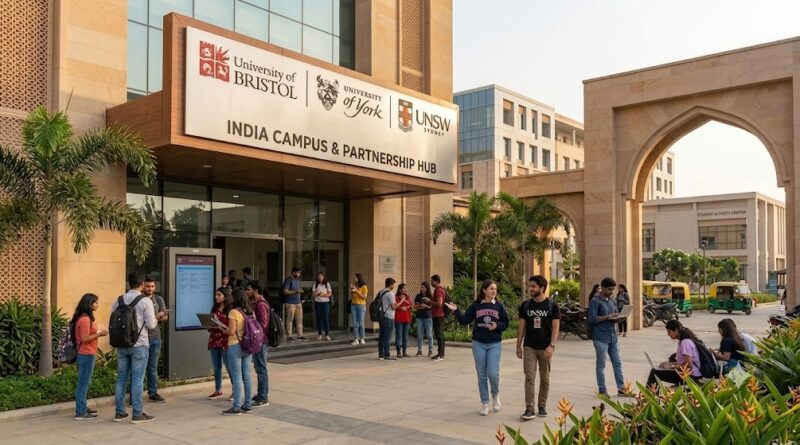
The Global Campus in India: Bristol, York, and UNSW Are Officially India-Bound
Tuesdays in New Delhi are usually reserved for dry, bureaucratic press releases. But this week, the Ministry of Education dropped a geopolitical game-changer into the higher education landscape.
Three heavyweight global institutions—the University of Bristol, the University of York, and the University of New South Wales (UNSW)—officially received their Letters of Approval (LoAs) to establish physical brick-and-mortar campuses in India.
The ceremonial hand-off by Dr. Vineet Joshi (Secretary of Higher Education and UGC Chairman) in the presence of Union Education Minister Dharmendra Pradhan wasn’t just a photo-op. It marks the official crossing of the Rubicon for the National Education Policy (NEP) 2020. The “internationalisation” of Indian education is no longer a lofty policy deck; it has wheels on the ground.
Meeting the New Class: Who’s Coming to Town?
The choice of these three universities signals a deliberate play for high-ranking, research-heavy institutions rather than predatory, degree-mill satellites.
- The UK Contingent (Bristol & York): Bringing traditional British academic rigor, a strong emphasis on critical humanities, and cutting-edge stem research.
- The Australian Powerhouse (UNSW): A member of the prestigious Group of Eight, UNSW is a global juggernaut in engineering, technology, and business-industry partnerships.
By bringing these brands to India, the government is effectively attempting to reverse—or at least contain—the massive brain drain and capital flight that sees hundreds of thousands of Indian students leaving shores every year.
The NEP 2020 Dream: Beyond the Horizon
According to Education Minister Dharmendra Pradhan, this move is a vital catalyst for the Indian academic ecosystem. The influx of these foreign universities is expected to create a three-pronged benefit:
- Democratizing Global Learning: Students who cannot afford the astronomical living costs of London or Sydney can now access the exact same curriculum and pedigree locally.
- Elevating Research Collaboration: Local Indian universities will now have hyper-local access to global research networks, leading to co-authored papers, joint patents, and shared labs.
- Fostering Quality Competition: The presence of top-100 global universities next door will naturally force domestic institutions to upgrade their infrastructure, curriculum, and faculty standards.
The Real Litmus Test Lies Ahead
While we celebrate this historic policy win, a veteran eye must look past the glittering signing ceremony. Setting up a campus is the easy part; sustaining its elite reputation is where the real work begins.
The success of Bristol, York, and UNSW in India will depend entirely on three critical questions: Will they deploy permanent, world-class faculty to India, or rely on flying-visitors? Will the fee structure remain accessible to India’s bright middle-class talent? And most importantly, will they be granted the true operational autonomy required to maintain their global standards without getting tangled in red tape?
The Bottom Line
For decades, Indian higher education operated behind a protectionist wall. Today, that wall has completely crumbled, replaced by a bridge. The arrival of Bristol, York, and UNSW proves that India is no longer just a major exporter of student talent—it is officially a premier global education destination. For the newly launched Indian academic year, the competition just got a whole lot more interesting. Stay tuned to this space as we track how these campuses take shape.