
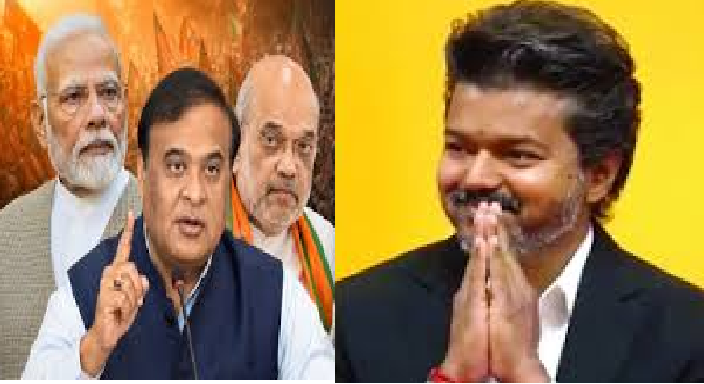
Political Sea Change: Vijay Takes Tamil Nadu; Sarma Retains Assam
Sunday and Tuesday have marked a historic week in Indian state politics. From the roaring crowds at Chennai’s Jawaharlal Nehru Stadium to the strategic huddles in Guwahati, the political map is being redrawn.
In the South, a decades-old duopoly has finally cracked, while in the Northeast, a seasoned leader cements his legacy. Here is your breakdown of the major shifts.
Tamil Nadu: The “Thalapathy” Era Begins
In a move that officially ends the bipolar DMK-AIADMK dominance that has defined Tamil Nadu since 1967, actor-turned-politician C. Joseph Vijay was sworn in as the State’s Chief Minister on Sunday.
Vijay, 52, took the oath in his signature “punchy style” before a sea of emotional supporters and national leaders, including Rahul Gandhi. Notably, he is the first member of a minority religious denomination to hold the state’s top post.
The New Cabinet: Fresh Faces
The initial Ministry is lean but signals a departure from the old guard:
- Total Members: 9 (plus the CM).
- New Blood: 8 out of the 9 are first-time Ministers.
- Diversity: Includes one woman Minister in the initial lineup.
- Expansion: A larger reshuffle is expected after the floor test on May 13, likely forming the state’s first-ever coalition government.
Day One: Three Major Files Signed
Wasting no time, CM Vijay signed three major executive orders directly from the stage:
- Free Electricity: 200 units of free power for domestic consumers (for those using under 500 units bimonthly).
- Women’s Safety: The creation of the “Singa Pen [Lioness] Special Force,” featuring 65 police stations across 37 districts.
- Anti-Narcotic Task Force: A dedicated unit to crack down on the illegal drug trade.
The “White Paper” Promise: Vijay didn’t hold back on his predecessors, accusing the DMK of leaving a ₹10-lakh-crore debt. He promised a “White Paper” on the state’s finances and a zero-tolerance policy for corruption within his own ranks.
Assam: Himanta Biswa Sarma’s “Double Engine” Continuity
While Tamil Nadu saw a revolution, Assam opted for continuity. Himanta Biswa Sarma is set to take the oath as Chief Minister for a second successive term this Tuesday after a dominant performance by the BJP-led NDA.
The Road to the Second Term
The transition was seamless, following a meeting of the 126-member Assembly where Sarma was unanimously elected as the NDA leader.
- The Coalition: The government remains a partnership between the BJP, Asom Gana Parishad (AGP), and Bodoland People’s Front (BPF).
- VVIP Guest List: The ceremony will be a high-profile affair attended by Prime Minister Narendra Modi, Amit Shah, Rajnath Singh, and JP Nadda.
A Culture of Accountability
BJP President JP Nadda emphasized that the second term would focus on a “new culture” of governance—one that is proactive, responsive, and accountable. With the leadership settled, the focus now shifts to fulfilling the NDA’s ambitious development agenda for the state.
Whether it’s Vijay’s “One Centre” leadership in the South or Sarma’s “Second Innings” in the Northeast, the message from voters is clear: they want results, transparency, and a break from the status quo of the past.