
Mission Aagaman: How a Privately Built Rocket Just Re-Engineered India’s Space Odyssey
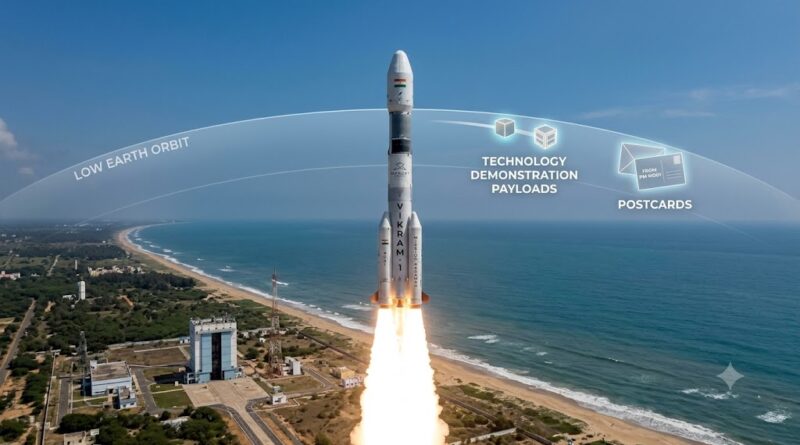
SRIHARIKOTA: On a historic Saturday at 12:05 p.m., Vikram-1—India’s first privately developed orbital rocket—lifted off from the Satish Dhawan Space Centre, successfully deploying multiple technology payloads into Low Earth Orbit (LEO). Appropriately dubbed ‘Mission Aagaman’ (Arrival), the launch makes India only the third country in the world to achieve orbital insertion using a privately engineered launch vehicle.
The Seven-Storey Carbon Marvel
Developed by Hyderabad-based aerospace startup Skyroot Aerospace, Vikram-1 is not just another rocket; it is a highly sophisticated piece of modern manufacturing.
- The Architecture: A seven-storey-tall, multi-stage orbital vehicle built entirely with an all-carbon composite structure.
- The Powerhouse: Fueled by in-house developed propulsion systems, featuring cutting-edge 3D-printed engines and high-thrust solid-fuel boosters.
- The Capability: Specifically engineered to democratize space access by carrying small satellites weighing up to 350 kg into LEO.
According to Pawan Kumar Chandana, co-founder and CEO of Skyroot, the flight successfully validated the rocket’s propulsion, avionics, and complex guidance and navigation systems under real, unforgiving operational conditions.
From Prime Ministerial Postcards to Cosmic Diamonds
Mission Aagaman wasn’t just a technical validation; it carried a eclectic mix of cargo that blended cutting-edge utility with cultural milestones. The rocket deployed six technology demonstration payloads from global and domestic players like Grahaa Space, Cosmoserve, DCubed, and Skyroot itself.
Tucked alongside the tech hardware were symbolic postcards—including one carrying a message from Prime Minister Narendra Modi—and a unique piece of micro-art alongside Cosmos Diamonds’ artwork, fittingly titled ‘Cosmic Bloom’.
A ‘Defining Moment’ in History
The success triggered immediate celebration at the highest levels of government. In a direct phone call to the Skyroot team, Prime Minister Modi hailed the launch as a landmark shift.
“The growing participation of our private sector is opening new frontiers and accelerating innovation. This achievement will encourage youngsters to dream bigger and innovate fearlessly.”
— Narendra Modi, Prime Minister of India
The historical poetry of the launch wasn’t lost on space observers. The triumph comes exactly 46 years after India launched its first experimental satellite launch vehicle, the SLV-3, on July 18, 1980, from the exact same venue—an event that originally inducted India into the exclusive club of spacefaring nations.
The Power of an Ecosystem
While Skyroot designed the vehicle, the victory belongs to a much larger matrix of Indian innovation. Pawan Goenka, Chairman of the Indian National Space Promotion and Authorization Centre (IN-SPACe), highlighted the sheer scale of collaboration required to pull off the feat.
“What lifted off today is the culmination of years of work, a team of over a thousand people, and the efforts of close to 400 suppliers,” Goenka noted. “You have given us an India moment.”
With a workforce heavily driven by a diverse mix of eager freshers and seasoned aerospace veterans, Skyroot’s successful debut signals that the global commercial small-satellite launch market has a formidable new competitor.