
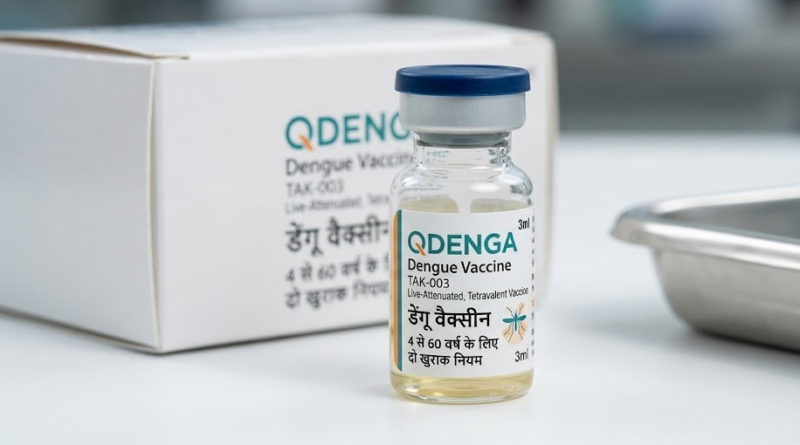
India Approves First-Ever Dengue Vaccine: DCGI Grants Market Authorization to Takeda’s QDENGA
NEW DELHI: In a landmark milestone for national public health, the Drug Controller General of India (DCGI) has granted market authorization to QDENGA (TAK-003), making it the first dengue vaccine to be approved in the country. Developed by Takeda Biopharmaceuticals, the clearance offers a crucial preventive weapon against a disease that accounts for nearly one-third of the global dengue burden.
Key Features & Administration
- Target Age Bracket: Approved for individuals aged 4 to 60 years.
- Tetravalent Coverage: It is a live-attenuated vaccine engineered to protect against all four circulating dengue virus serotypes (DENV-1, DENV-2, DENV-3, and DENV-4).
- Dosing Schedule: Administered as a two-dose regimen, given three months apart.
- Universal Application: The vaccine can be administered regardless of whether an individual has had a prior dengue infection and requires no pre-vaccination blood screening.
Clinical Efficacy and Safety Profile
The DCGI’s clearance is backed by an extensive global clinical development program involving over 28,000 participants across 19 Phase I, II, and III trials, alongside a dedicated Phase III study conducted in India:
- Infection Prevention: Demonstrated an overall efficacy of 80.2% against virologically confirmed dengue 12 months after receiving the second dose.
- Hospitalization Reduction: Showed a 90.4% reduction in dengue-related hospitalizations at 18 months post-vaccination.
- Indian Clinical Trial Data: Evaluated safety and immunogenicity in domestic participants aged 4 to 60, confirming the jab to be safe, well-tolerated, and immunogenic across children, adolescents, and adults.
Global Footprint & Significance for India
Over the last two decades, reported dengue cases in India have increased nearly 11-fold due to rapid urbanization, changing weather patterns, and shifting vector habitats.
QDENGA has already been approved in 43 countries across Europe, Asia, and Latin America, with over 32 million doses distributed through public and private healthcare channels globally. Its arrival in India provides a vital immunisation tool to complement existing vector control, sanitation, and public health interventions.