
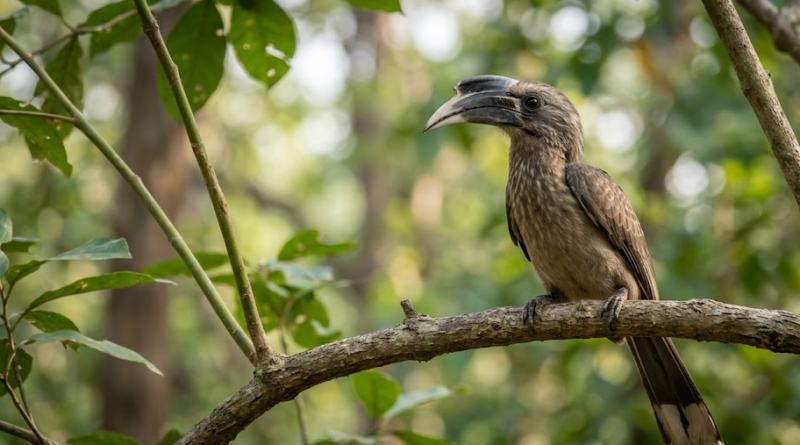
Six Decades Later, the Indian Grey Hornbill Makes a Triumphant Return to Gir
GANDHINAGAR: In a major victory for avian conservation, the Indian Grey Hornbill has successfully reclaimed its historic home in Gujarat’s Gir forests. More than 60 years after vanishing entirely from the region, the species has recorded four consecutive years of successful breeding following a meticulously planned reintroduction program.
This headline-grabbing achievement underscores a broader winning streak for Gujarat’s wildlife. The state recently celebrated another massive milestone. That is the survival of a second Great Indian Bustard chick hatched via the innovative “jump-start” technique and it has past its critical 40-day mark.
A Proven Success in the Skies
The details of the hornbill’s resurgence were unveiled in a comprehensive study titled “Reintroduction of Indian Grey Hornbills in Gir, India: Insights into Ranging, Habitat Use, Nesting and Behavioural Patterns,” published in the prestigious international peer-reviewed journal Birds.
The initiative, spearheaded by the Gujarat Forest Department and its conservation partners, has effectively reversed a local extinction that dates back to the 1950s and 1960s.
“Wildlife conservation in Gujarat has entered a new phase, particularly in species recovery and the protection of rare and endangered wildlife. The research conducted following the reintroduction of the Grey Hornbill into the Gir forests is a significant success for us.”
— Arjun Modhwadia, Forest and Environment Minister
By The Numbers: The Reintroduction Strategy
The project wasn’t just about releasing birds and hoping for the best; it was a highly monitored, phased scientific operation.
- Total Cohort: 40 Indian Grey Hornbills were released into the wild.
- Phase 1 (2021–2022): 28 birds were initial pioneers in the Gir landscape.
- Phase 2 (2023): 12 more birds were released to bolster the population.
- Satellite Surveillance: 11 males were fitted with satellite transmitters, allowing researchers to track their movements, territory establishment, and breeding habits in real-time.
Why the Hornbill’s Return Matters
The return of the Grey Hornbill is about much more than just ticking a box for biodiversity; it is a vital functional upgrade for the Gir ecosystem. Hornbills are often referred to as the “farmers of the forest” due to their unique dietary habits.
According to Vinod Rao, Principal Secretary of Forests and Environment, the bird plays a crucial ecological role as a long-distance seed disperser. By eating fruits and transporting seeds across vast distances, they naturally aid in the regeneration of fruit-bearing trees and the overall health of the forest.
The data proves they are settling in comfortably. While only a single pair successfully bred in the first year after the release, three additional pairs nested in the second year—clear evidence that this restored population is now multiplying naturally without human intervention.