
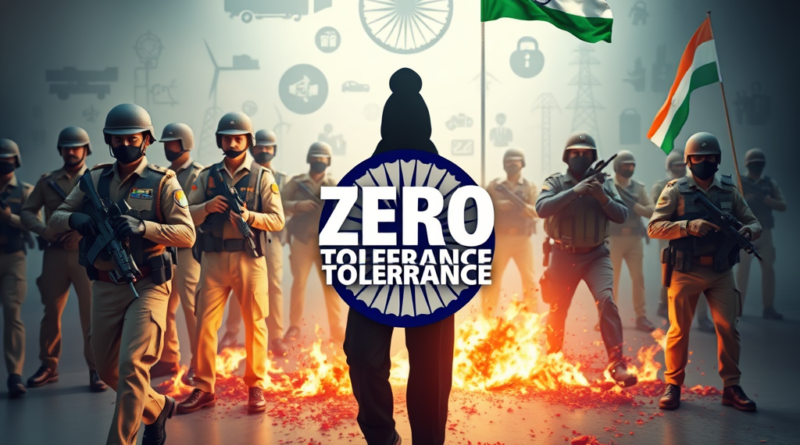
India’s Internal Security Doctrine Gets a New Edge with ‘PRAHAAR’
In what can only be described as a tectonic shift in India’s internal security architecture, the Union Home Ministry has finally pulled the curtain back on its most ambitious project to date: PRAHAAR.
As a reporter who has covered the North Block beat for over two decades, I’ve seen many “drafts” and “memos,” but PRAHAAR is different. It isn’t just a policy document; it is a clear, aggressive doctrine that signals the end of India’s reactive stance. For the first time, the country has a unified National Counter-Terrorism Policy and Strategy that acknowledges a chilling reality—the battlefield is no longer just the LoC; it is in our power grids, our space stations, and our digital wallets.
The Multi-Front Challenge
The policy highlights a “three-front” threat—water, land, and air—but adds a critical fourth dimension: the Fifth Domain (Cyber). The Home Ministry is blunt in its assessment: nation-states and criminal hackers are no longer just “probing” our defenses; they are actively targeting the “crown jewels” of our economy, from atomic energy plants to aviation hubs.
Dismantling the ‘Ecosystem’
What stands out in PRAHAAR is the shift in focus from the terrorist to the ecosystem. Home Minister Amit Shah’s fingerprints are all over this strategy, particularly the move to “criminalize” every cog in the machine. It’s no longer just about the man with the gun; it’s about the financier in a high-rise office and the “local outfit” providing terrain knowledge.
The document is surprisingly candid about the “Terror-Crime Nexus.” It notes that global giants like al-Qaeda and ISIS are increasingly outsourcing their logistics to organized criminal networks. By targeting these logistics chains, the MHA intends to make terror “unaffordable and unsustainable.”
The New Tools of Terror: Drones and Dark Web
Veteran security analysts will note the policy’s emphasis on “technological asymmetry.” The use of drones for “payload drops” in Punjab and J&K has moved from a nuisance to a top-tier national security threat. PRAHAAR calls for a massive technological upgrade to intercept CBRNED (Chemical, Biological, Radiological, Nuclear, Explosive, and Digital) materials.
Furthermore, the policy tackles the “anonymity” of the modern terrorist. With the mention of crypto-wallets and the Dark Web, the government is signaling a massive investment in digital forensics.
A Unified Response
Perhaps the most ambitious—and potentially contentious—part of the policy is the call for a Uniform Anti-Terrorism Structure across all states. In a federal setup where “Police” is a state subject, standardizing processes and procedures is a Herculean task. However, following the Pahalgam incident in April 2025, the NIA has been pushing for this “synergistic response” to ensure that a terrorist cannot exploit the gaps between state jurisdictions.
The Bottom Line
PRAHAAR is a sophisticated blend of “hard” and “soft” power. While it talks of drones and interceptions, it also underscores the role of community leaders and “moderate preachers” to stem the tide of radicalization.
The message from New Delhi is loud and clear: The era of “wait and watch” is over. India has defined its targets, and with PRAHAAR, it finally has the roadmap to strike back at the roots of terror.