
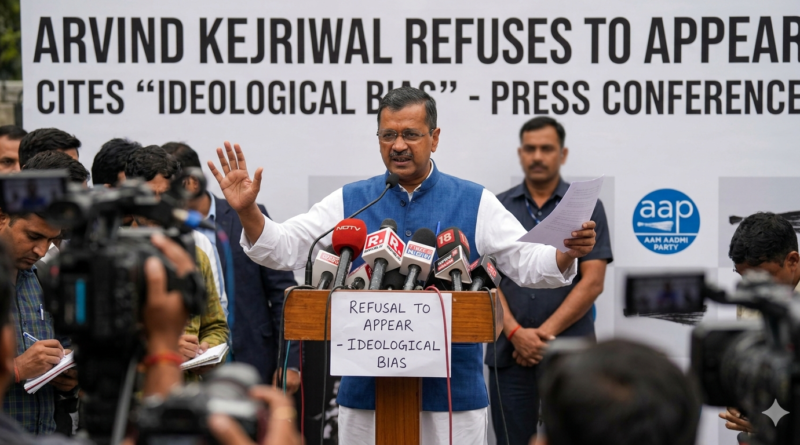
Arvind Kejriwal Refuses to Appear Before Justice Swarana Kanta Sharma; Cites ‘Ideological Bias’
NEW DELHI — In a move that has sent ripples through the national capital’s legal and political circles, Aam Aadmi Party (AAP) chief Arvind Kejriwal announced on Monday that he would no longer participate in the Delhi excise policy case proceedings before Justice Swarana Kanta Sharma.
Kejriwal stated that he will not appear either in person or through legal counsel, framing his decision as an act of “Satyagraha” based on Gandhian principles.
The Recusal Conflict
The development follows Justice Sharma’s April 20 decision to reject Mr. Kejriwal’s plea for her recusal from the case. The AAP leader had sought a different bench, alleging a potential conflict of interest.
In a statement shared on X (formerly Twitter), Kejriwal questioned the possibility of receiving a fair trial:
“The government of the RSS ideology imprisoned me through false allegations; the judge herself has acknowledged that she has repeatedly attended platforms of Akhil Bharatiya Adhivakta Parishad, an organisation linked to that ideology. In such a situation, can I receive justice before her?”
‘His Own Judge and Witness’: BJP Hits Back
The decision has drawn sharp criticism from the ruling dispensation. Delhi Chief Minister Rekha Gupta (of the BJP) condemned the move, suggesting that Kejriwal’s conduct undermines the sanctity of the judiciary.
“Mr. Kejriwal is acting as his own lawyer, witness, and judge,” Gupta said, accusing the AAP chief of attempting to bypass established legal protocols when judicial outcomes do not favor him.
Legal Implications of Non-Appearance
Legal experts note that refusing to appear or be represented in a High Court proceeding is a rare and risky strategy. Potential consequences include:
- Ex-parte Proceedings: The court may choose to hear the case and pass orders in the absence of the accused’s defense.
- Contempt of Court: While Kejriwal cited “respect for the judiciary,” a persistent refusal to engage with a court-mandated process could lead to further legal complications.
Background of the Case
Justice Swarana Kanta Sharma has presided over several critical hearings regarding the Delhi excise policy. The case, which involves allegations of corruption and money laundering in the formulation of the now-scrapped 2021-22 liquor policy, has seen several high-profile AAP leaders taken into custody over the past two years.