
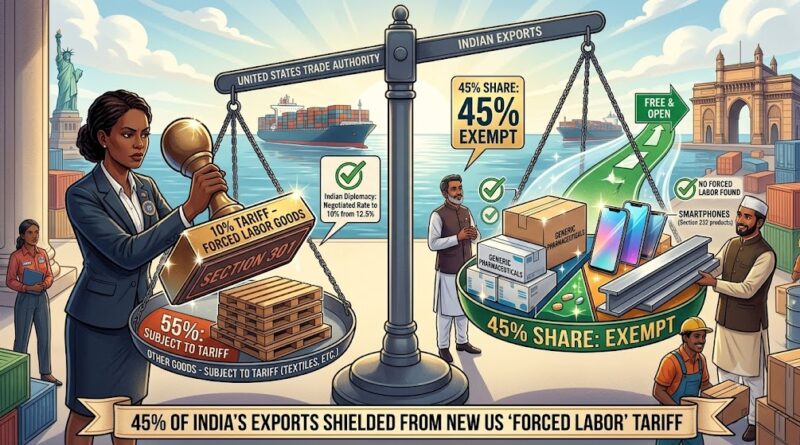
45% of India’s Exports Exempt From New U.S. Forced Labor Tariffs: Centre
NEW DELHI: The Ministry of Commerce and Industry stated on Saturday that approximately 45% of India’s exports to the U.S. remain outside the purview of the new 10% tariff. This development came after the United States announced permanent tariffs on imports from 60 trading partners over forced labor goods.
The Centre also highlighted that India’s tariff incidence remains comparatively lower than that of most other major economies.
Key Takeaways & Scope of Exemptions
- Lower Than Initial Proposal: The final additional duty rate stands at 10%, which is lower than the initially proposed 12.5% on India and select other nations.
- Excluded Product Categories: A substantial share of exports—including generic pharmaceuticals, smartphones, and other specified goods—attract zero additional duties.
- Section 232 Exclusions: Steel, aluminum, and auto parts, which are already covered under Section 232 of the U.S. Trade Expansion Act (ranging from 25–50%), are not subject to this new 10% duty. Because Section 232 duties apply globally, India faces no relative disadvantage.
- Lower Duty Tier: Following sustained engagement with the U.S. Trade Representative (USTR), India was placed in the lower tier of additional tariffs. Out of 60 investigated countries, India’s tariff rate is lower than that of 38 other nations.
Official Statement from Ministry
“On account of these exemptions, an estimated 45% of India’s exports to the U.S. remain outside the purview of the additional 10% Section 301 duty… Although the remaining 55% of exports will attract the additional 10% duty, India’s tariff incidence is comparatively lower than that for most other economies.”
— Ministry of Commerce and Industry
Status on Textile Exports
- USTR’s Textile Mechanism: The USTR report provided for a “textile mechanism” using tariff-rate quotas for Bangladesh, Cambodia, Indonesia, and Malaysia to incentivize imports of U.S. cotton and textile products.
- Ongoing Negotiations: Although India was not included in this specific mechanism, the Indian government confirmed that it remains closely engaged with the U.S. regarding a quota-based framework for India’s textile exports.