
India Unveils Blueprint for Bioeconomy Transformation
NEW DELHI — In a major push to establish India as a global biotechnology powerhouse, NITI Aayog has unveiled its comprehensive strategy document, “Roadmap for Building India as a Leading Bioeconomy Powerhouse by 2035.”
The policy roadmap shifts India’s approach from broad frameworks to a mission-mode execution strategy. Backed by new financial mechanisms, regulatory reforms, and cross-ministerial governance, the plan aims to propel the nation into the world’s top three biotechnology powers by 2035.
Key Targets & Economic Projections
The roadmap lays out an aggressive trajectory to transition laboratory research into market-ready commercial solutions:
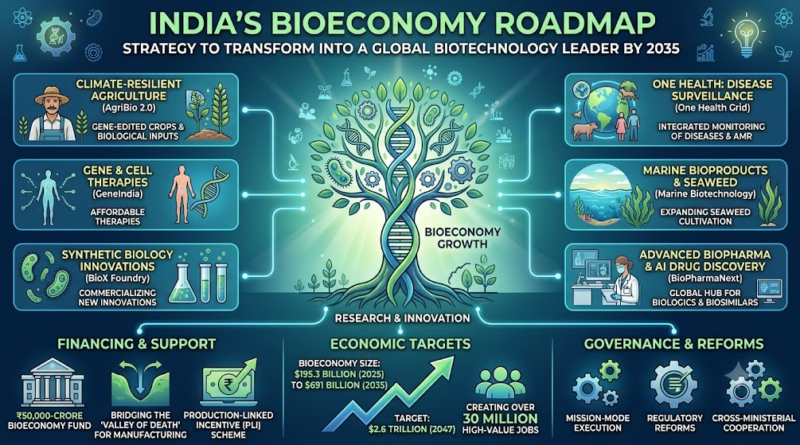
- Bioeconomy Scale-Up: Expand the bioeconomy from 195.3 billion Dollar (2025) to 691 billion Dollar by 2035, ultimately targeting 2.6 trillion Dollar by 2047.
- Job Creation: Generate over 30 million high-value jobs across advanced manufacturing, research, and computational biology.
- Global Footprint: Establish at least 15 globally competitive biotechnology companies headquartered in India.
The Centerpiece: Bridging the “Valley of Death”
The centerpiece of NITI Aayog’s strategy is the proposed 50,000-crore Rupees BioEconomy Growth Fund (2026–2035). The fund is designed specifically to solve the biotechnology sector’s persistent “valley of death”—the critical capital gap between proof-of-concept research and full commercial-scale manufacturing.
“The goal is not to just research but to build globally competitive biotechnology companies.”
— Debjani Ghosh, Distinguished Fellow, NITI Aayog
How the Fund & Policy Framework Work
- Financial Instruments: Combines blended finance, equity-risk instruments, viability-gap funding, and direct infrastructure support.
- PLI Scheme: Introduces a Production-Linked Incentive (PLI) scheme dedicated to biomanufacturing to scale domestic output and curb import reliance.
- Core Focus Areas: Biomanufacturing, advanced therapeutics, synthetic biology, fermentation platforms, biomaterials, and diagnostics.
Six Targeted National BioMissions
To drive measurable outcomes by 2035, the report outlines six sector-specific National BioMissions, each led by dedicated ministries:
| Mission Name | Core Objective | Primary Deliverables |
| GeneIndia | Advanced Therapeutics | Affordable gene/cell therapies and precision diagnostics. |
| AgriBio 2.0 | Sustainable Agriculture | Climate-resilient gene-edited crops & biological farm inputs. |
| BioX Foundry | Synthetic Biology | Commercializing synthetic biology & engineering biosystems. |
| One Health Grid | Disease Surveillance | Integrated monitoring of infectious diseases & antimicrobial resistance. |
| Marine Biotechnology | Blue Economy Expansion | Commercializing seaweed cultivation and marine bio-products. |
| BioPharmaNext | Next-Gen Biopharma | Establishing India as a global hub for biologics, biosimilars, and AI-led drug discovery. |
Governance and Regulatory Streamlining
To move beyond the foundation laid by the Biotechnology for Economy, Environment and Employment (BioE3) policy, the report recommends new governance architecture:
- Empowered Committee on National BioMissions: To ensure seamless cross-ministerial coordination.
- National BioData Council: Dedicated to establishing robust data governance for biological and health datasets.
- Fast-Track Regulatory Pathways: Modernizing regulatory bodies (such as CDSCO) and creating regulatory sandboxes to accelerate approvals for cell/gene therapies, AI-designed drugs, and synthetic biology.
- Bio-IP Accelerated Pathway: Speeding up patenting processes to safeguard domestic innovations.